
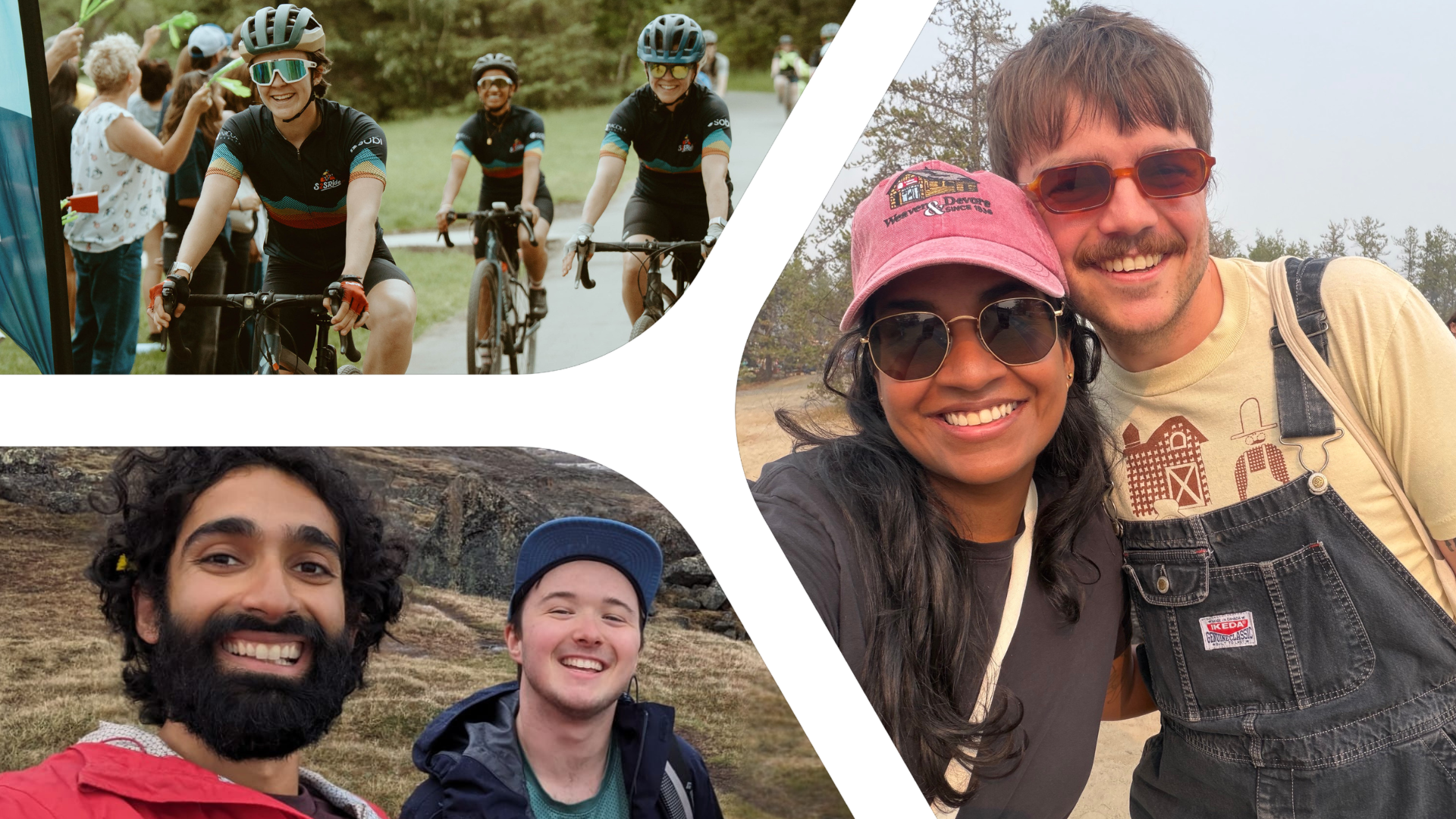
On the morning of June 15th, McCall MacBain Loran Scholar Kira Young (’24) arrived in Edmonton, AB, after a 10-day bike ride. When Kira got sick with a rare autoinflammatory disease in grade 10, she had to travel from her hometown of Yellowknife, NT, to Edmonton, AB, over a dozen times to access necessary healthcare. According to Kira, it’s a common story: chronic and critical medical conditions require expensive travel to urban healthcare centres for diagnosis and management.
“In grade 12, during a particularly acute episode of illness in Edmonton, I started dreaming of retracing the route from Yellowknife to Edmonton that people in the North travel so often,” Kira explained. That experience inspired her to cycle the 1,600 km from Stanton Territorial Hospital in Yellowknife to the Stollery Children’s Hospital in Edmonton to call attention to limited healthcare access in Northern, rural, and remote Canada.
Loran alumna Justina Marianayagam (‘11) has dedicated her life to reducing the medical inequities Kira and so many like her face every day. Originally from the Northwest Territories, Justina is a pediatric resident physician based primarily at the British Columbia Children’s Hospital, providing specialized medical care for children and youth across BC and the Yukon, with a focus on developmental concerns, trauma-informed care, and access in underserved regions.
“The Canadian healthcare system is under immense strain and is long overdue for reform, especially in this post-pandemic world,” Justina explains. In rural or remote regions with limited resources, she said it can be difficult for medical professionals to deliver consistent, culturally respectful, specialized pediatric care. Justina plans to return to Yellowknife to establish a pan-territorial medical licensing program that will help expand the North’s independence within the medical system.
Justina isn’t the only Loran alum working in the North. In fact, there’s a thriving and close-knit community of Loran Scholars, alumni, volunteers, and supporters living and working across the Territories. Justina recently met fellow alumni Maya Fernandez (’08) and Emma Willoughby (’19) in Yellowknife for the annual folk festival to cheer on musician Braden Lam (’16) as he performed.
Loran alumni worldwide work to build a network of engaged citizens dedicated to fostering meaningful change, but the strong alumni community in the Territories share a special bond. “There are people to bounce our ideas off of and collaborate with across different areas of public and private sectors,” said Iqaluit-based psychiatrist Gaurav Sharma (’11). “When we are in community with people who are in completely different professions, there’s a possibility to generate change in different and exciting ways.” Not too long ago, he ran into another Loran alumnus, Cai Mitchell (’20), while on his Loran Summer working as a policy researcher for Nunavut Health.
“I have had the pleasure of running into both past and present Loran Scholars around Yellowknife this summer. It always brings my heart joy to hear their stories and personal journeys,” said Judy Whitford, Indigenous Language Coordinator with the Government of the Northwest Territories.
Judy has been a Loran selections volunteer since 2020 and is the chair of the Northern committee, playing a critical role in assessing and interviewing candidates from Northern and rural communities. “In the Territories, relationships are at the heart of meaningful change. We live in a vast region with diverse peoples and experiences. However, for generations, we have survived through shared knowledge and collective understanding. In many ways, Loran is comparable. Building strong connections among Loran Scholars, alumni, volunteers, Elders, and community supporters creates opportunities for learning across generations. Young people gain encouragement, mentorship, and a sense of belonging, while more experienced leaders learn from the ideas, energy, and perspectives of youth.”
Keith Halliday, Partner and Associate Director of the Center for Geopolitics at Boston Consulting Group, shares a similar sentiment: “The territories are growing fast, changing and adapting quickly.” Also in Whitehorse, Keith has been a Loran selections volunteer since 2018. “Helping Northerners go outside the region, learn, develop, build their toolkits across character, service, and leadership, and then come home and contribute to their communities in whichever way they think is best is fundamentally important to the long-term development of our societies in the North—for both indigenous and non-indigenous Yukoners.”
Gaurav agreed, saying Nunavut is experiencing rapid change, as well. “Where there’s change, you need leadership; people ready with character, ready to provide service with integrity—especially in a place where change comes with the historical context of colonialism.” After nearly a decade of visiting Iqaluit, Gaurav officially moved from his hometown of Brampton, ON in 2024. He believes true leaders seek direction from the community and take action where needed. Gaurav works with people experiencing acute mental illness, creating holistic treatment programs that consider social and cultural factors, in addition to the medical and psychological. As the inaugural chief psychiatrist for the territory, he helps deliver psychiatric care closer to home.
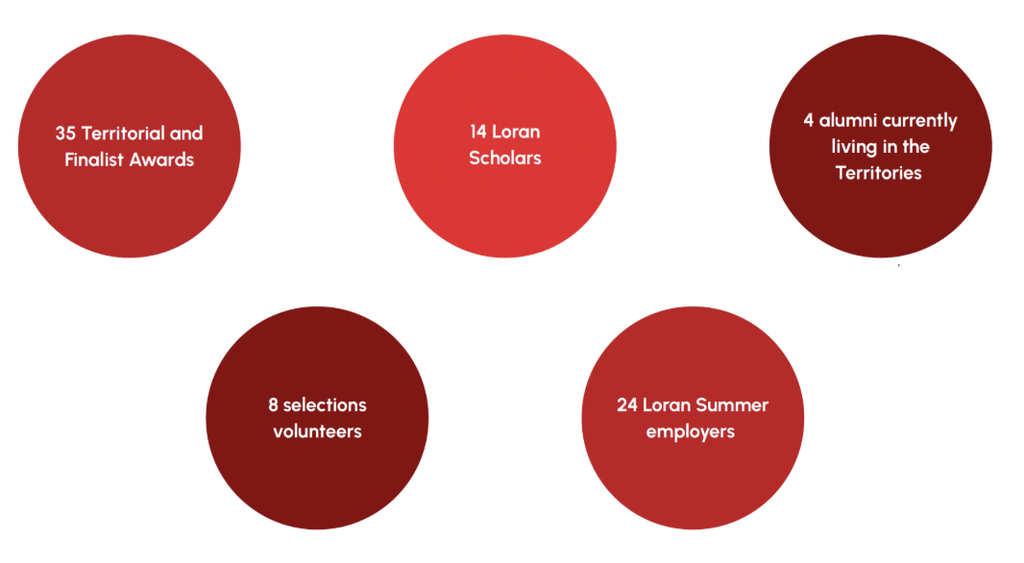
Students from the Territories bring unique and valuable perspectives to community leadership. It’s evident in the empathy, integrity, and purpose demonstrated by the 14 Loran Scholars and 35 Loran Finalists who have come from the Territories since 1999. Kira cites the land and neighbours for her tenacity, saying they both shaped her profoundly. “The challenges and strengths associated with living in the North instilled in me the values of creative problem solving, community cultivation, and reciprocity with both people and the environment,” she explained. “Some of my most important traits as a student and a leader stem from my Northern experience and identity.”
For Justina, Loran’s leadership-enrichment program offered the support she needed to drive positive change in communities like her own. She believes the key is to empower youth to lead with their values as young as possible. “Loran gave me the mentorship and financial freedom to explore Northern and international healthcare early on—experiences that cemented my passion for providing rural medical care,” she explained.
During her bike ride, Kira confided that she doubted her ability to achieve her goals. She had never biked more than 250km in a weekend, let alone 1600km over 10 consecutive days, but her steadfast belief in her mission kept her going. “I was continuously inspired by my fellow Loran Scholars and the network of Loran alumni, who remind me that values aren’t supposed to be abstract,” said Kira.
“This ride may be the most substantial manifestation of my values thus far: grit, creative activism, community-building, and adventure,” Kira continued. “This project would not have been possible without Loran’s encouragement to take a meaningful risk and step off the path of least resistance, guided by bold, value-rooted goals.”
Over the course of her ride, Kira connected with many people with similar stories, while raising over $77,000 to support other Northern and rural families affected by rheumatic diseases. She also learned an important lesson: “Ambition, hope, and optimism are highly contagious! Taking on a bold project and persisting through uncertainty can unite a community and make a big impact.”
As summer comes to a close, Kira is gearing up to make another long trip; this time back to McMaster University in Hamilton, ON, to continue her degree in Arts and Sciences. Despite the distance, she makes a concerted effort to remain engaged with her community in Yellowknife during the school year and returns home when she can. “Bringing back my skills and knowledge feels natural and exciting,” she shared. “One of the most meaningful ways that I believe I can make a difference is in continuously striving to use what I have learned to benefit my communities.”